Singapore BTO & New Condo TOP Balcony Setup Checklist: Blinds, Awnings, or Canopies? (2026 Guide)
August 14, 2026
Singapore HDB & MCST Balcony Shading Regulations: The 2026 Compliance Guide for Awnings and Outdoor Blinds
August 16, 2026Beat Singapore’s Record Heatwaves & Monsoon Downpours: The 2026 Extreme Weather Awning & Blind Selection Guide
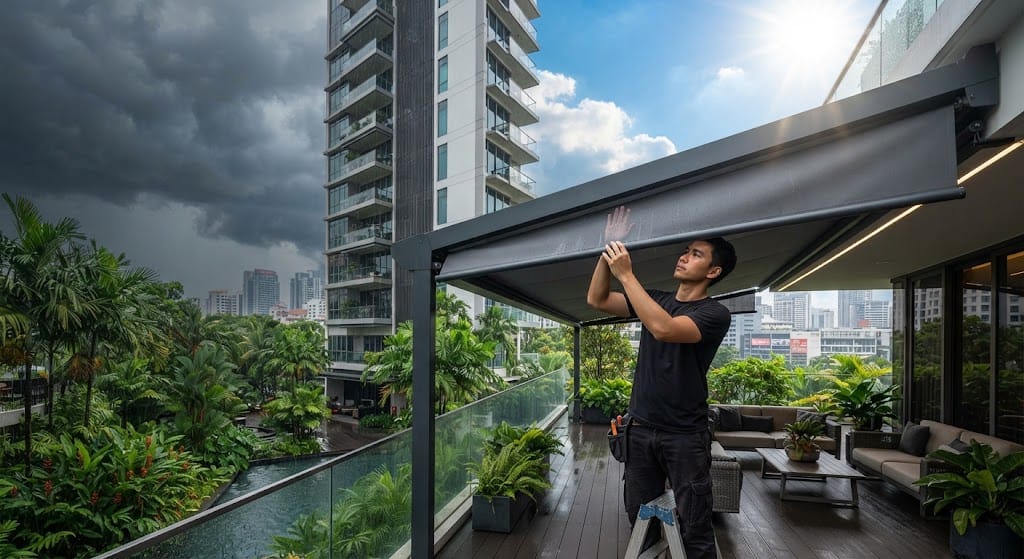
Engineering outdoor shading systems to withstand NEA extreme heat advisories and monsoon wind gusts in Singapore.
Singapore’s microclimate presents one of the most punishing architectural environments in Southeast Asia. Located just one degree north of the equator, our island experiences intense solar irradiance that regularly drives ambient ground temperatures past 35 degrees Celsius. The National Environment Agency (NEA) regularly issues extreme heat and high UV index advisories, with readings frequently reaching the extreme Level 11 and Level 12 bands. Within hours, this oppressive heat can be interrupted by violent Sumatran squalls, generating sudden convective wind gusts of up to 75 km/h and intense tropical downpours that dump over 100mm of rain per hour.
For landed homeowners with open garden patios and condominium residents living on high floors along the East Coast, Punggol, or Bukit Timah, standard interior window furnishings provide practically zero defense against these aggressive weather swings. Drawing indoor blackout curtains after sunlight strikes your sliding glass doors does nothing to stop the heat; thermal energy has already penetrated the glass, turning your living room into an insulated greenhouse. When a sudden afternoon squall hits, unprotected outdoor spaces get flooded instantly, forcing you to rush out to drag soaked furniture indoors and mop up pooling water along sliding door tracks.
Protecting your home and outdoor space requires an engineered approach to external shading. Selecting the right outdoor system is not just about picking a fabric color that matches your exterior paint. It demands a solid grasp of solar thermodynamics, hydrostatic water resistance ratings, wind shear dynamics, and structural load limits. Whether you opt for a flexible dynamic canopy or a permanent hard shelter, every component must be calibrated to withstand Singapore’s environmental conditions.
Thermal Thermodynamics: Understanding Total Solar Energy Transmittance
To understand why low-grade outdoor shades fail to keep homes cool, you have to look at the physics of solar radiation. Sunlight reaching your balcony consists of three primary bands: ultraviolet (UV) radiation (approximately 3% to 5%), visible light (around 42% to 45%), and near-infrared radiation (roughly 50% to 55%). Infrared radiation is the primary source of ambient thermal heat.
When raw solar radiation strikes standard 6mm monolithic architectural glass, roughly 85% of that thermal energy passes directly into the interior living space through direct transmittance and secondary re-radiation. The interior surfaces—such as your timber flooring, ceramic tiles, and sofa fabrics—absorb these shortwave rays and re-radiate them as longwave heat, which cannot escape back out through the glass pane.
The Critical Metric: The g-tot Performance Value
The standard benchmark for evaluating shading performance under Singapore’s BCA Green Mark criteria is the g-tot value, which measures the Total Solar Energy Transmittance of the combined glazing and shading system. While standard clear glass has an unshaded solar factor (g-value) of roughly 0.82 to 0.85, an engineered external shading system dramatically lowers this figure:
- Unshaded Standard Glazing: g-value is approximately 0.85 (85% of total solar heat enters the room directly).
- Internal Blackout Roller Blinds: g-tot value ranges between 0.55 and 0.65 (Thermal energy passes through the glass before getting trapped in the gap, creating hot convection currents that raise indoor room temperature).
- High-Performance External Shading: g-tot value drops to between 0.08 and 0.15 (Stops up to 92% of total solar heat before it ever touches the building envelope).
Stopping solar radiation on the exterior perimeter is up to five times more effective than treating windows from the inside. By intercepting infrared wavelengths before they hit the glass, exterior shading stops thermal bridging, cuts air-conditioning power consumption, and helps lower your monthly SP Group electricity bills.
Comparative Solar Heat Ingress & Interior Thermal Buildup
Analysis of interior thermal heat gain through 6mm architectural glass under Singapore peak midday solar irradiance (1,000 Watts per square meter baseline).
Fabric Science: Hydrostatic Head Ratings and Waterproof Grading
Homeowners often assume that any thick outdoor canvas will keep their patio dry during an afternoon storm. This is a common and expensive mistake. There is a huge technical gap between fabrics that are merely water-repellent and materials engineered to be completely waterproof.
The standard benchmark for measuring water impermeability in architectural fabrics is the Hydrostatic Head Rating (ISO 811 / AATCC 127). This laboratory test measures the vertical height of a water column (in millimeters of water pressure, mm H2O) that a fabric can support before microscopic water droplets force their way through the weave.
Water-Repellent vs. Fully Waterproof Performance
Understanding hydrostatic head thresholds helps you avoid unexpected indoor leaks when monsoon squalls strike:
- Standard Water-Repellent Acrylics (Under 350mm H2O): Treated with basic fluorocarbon surface sprays to create a surface beading effect. While light morning drizzle rolls off easily, heavy monsoon downpours exert strong kinetic droplet force. Under sustained wind-driven rain, water penetrates right through the weave, causing heavy misting and dripping underneath.
- Marine-Grade Solution-Dyed Acrylics (1,000mm to 1,500mm H2O): Enhanced with polyurethane (PU) or resin back-coatings. These fabrics withstand severe downpours without leaking, making them suitable for folding-arm patio awnings installed with an adequate slope for water runoff.
- Composite PVC Membranes (Over 2,500mm H2O): Completely non-porous technical vinyls reinforced with high-tenacity polyester scrims. These membranes are impervious to water penetration even under low-pitch pooling conditions, providing a 100% waterproof barrier for landed verandas and open dining spaces.
Solution-Dyed Pigmentation vs. Surface-Coated Yarn
Singapore’s extreme UV exposure breaks down ordinary fabric dyes within months. In piece-dyed or yarn-dyed fabrics, color only coats the outer surface of the yarn. Within one to two years of tropical sun exposure, UV radiation degrades the chemical bonds, leading to severe fading, thread embrittlement, and seam tearing.
High-spec outdoor systems use 100% solution-dyed acrylic or mass-pigmented vinyl composites. The UV-stabilized pigments are mixed into the liquid polymer solution before the yarn filaments are extruded. The color runs completely through the cross-section of every single fiber, ensuring that the canopy preserves its tensile strength, water resistance, and rich color tone through years of intense afternoon sun.
| Shading / Roofing System | g-tot Thermal Rating | Hydrostatic Water Head (mm H2O) | Wind Resistance Threshold | Monsoon Rain Acoustic Damping | Optimal Property Fit |
|---|---|---|---|---|---|
| Retractable Folding-Arm Awnings | 0.10 to 0.15 High Heat Block |
1,200mm – 1,800mm (Requires 15° Slope or Steeper) |
Up to 45 km/h (Beaufort Force 6) |
Excellent (Muffled fabric thud) |
Landed Patios, Penthouse Roof Terraces, Ground Floor Units |
| Motorized Tensioned Zip Screens | 0.12 to 0.20 High Heat Block |
800mm – 1,500mm (Perforated Mesh) |
Up to 75 km/h (Beaufort Force 8–9) |
Excellent (Absorbs rain energy) |
Condo High-Rise Balconies, HDB Service Yards, Landed Verandas |
| Multiwall Polycarbonate Hard Roofing | 0.35 to 0.50 Moderate Heat Block |
Impervious (100% Waterproof) |
Up to 110+ km/h (Structural Frame Limit) |
Poor (Loud drum effect in downpours) |
Landed Car Porches, Covered Side Walkways |
| Insulated Composite Sandwich Panels | 0.05 to 0.08 Maximum Thermal Block |
Impervious (100% Waterproof) |
Up to 120+ km/h (Engineered Steel/Alu Frame) |
Superior (PIR core deadens impact sound) |
Landed Rear Extensions, Open Car Porches, Heavy Outdoor Kitchens |
| Motorized Bioclimatic Aluminum Louvers | 0.08 to 0.12 High Heat Block |
Impervious (Integrated Internal Gutters) |
Up to 90 km/h (Closed Lath Interlock) |
Moderate (Metallic rainfall sound) |
Landed Courtyards, Luxury Villa Patios, Rooftop Pavilions |
The Showdown: High-Tech Fabric Awnings Versus Hard Roofing Systems
When upgrading an outdoor living area in Singapore, the central decision comes down to choosing between an adaptable fabric system and a permanent hard roof structure. Both systems serve distinct architectural purposes, and picking the wrong one can lead to regulatory non-compliance or poor everyday usability.
Flexibility and Spatial Adaptability
Modern weather-resistant retractable awnings provide dynamic adaptability for homeowners who want weather protection on demand without permanently boxing in their outdoor space. When extended, a heavy-duty folding-arm awning shades outdoor decking from scorching midday heat, lowering ambient patio surface temperatures by up to 8 degrees Celsius. During cool evenings or clear nights, the canopy retracts completely into a slim cassette, restoring natural airflow and open skyline views.
In contrast, hard roofing systems—such as solid polycarbonate, laminated glass, or insulated composite sandwich panels—create fixed, permanent overhead shelters. While they provide continuous protection against heavy downpours, they also permanently restrict natural daylight into adjacent indoor rooms, which can leave indoor living areas feeling noticeably darker on overcast mornings.
Structural Load Limits and Regulatory Approvals
The engineering demands and regulatory requirements of hard roofing versus retractable fabric canopies differ significantly across property types:
- Dead Load on Facade Walls: A motorized retractable fabric awning weighs roughly 35 to 60 kg across a 5-meter span. A permanent steel-framed laminated glass canopy of the same dimensions often exceeds 450 to 600 kg. This substantial dead load requires deep structural anchoring, certified Professional Engineer (PE) calculations, and formal BCA structural lodgment.
- URA Gross Floor Area (GFA) Directives: For private condominium balconies and open sky terraces, installing a permanent hard roof is strictly prohibited under URA building envelope guidelines because it creates unauthorized Gross Floor Area. In these strata-titled homes, retractable fabric awnings and approved tensioned drop screens are the only legal shading options.
- Rainwater Drainage Management: Hard roofs require dedicated downpipes and internal gutter channels sized to handle heavy water flow without overflowing into neighboring properties. Retractable awnings rely on continuous fabric tension and a calibrated slope (minimum 15 degrees) to shed rainwater rapidly off the front profile.
Wind Shear Engineering: Surviving Sumatran Squall Vortexes
Every year between May and November, Singapore experiences the Southwest Monsoon season, bringing frequent early morning and midday Sumatran squalls. These weather systems do not build up gradually. They generate sudden, violent downdrafts that slam directly into building facades with minimal advance warning. For homeowners living in high-rise condominium towers along coastal corridors or landed properties surrounded by open fields, these squalls create massive structural stress on outdoor shading fixtures.
When wind strikes an extended awning or drawn outdoor blind, it generates both positive pressure (pushing against the material) and negative aerodynamic uplift (suction pulling the shade upward and away from the building). Under the Singapore Standard Design Code for Wind Loads (SS EN 1991-1-4), outdoor installations must withstand dynamic cyclical loading without joint deformation, arm warping, or bracket detachment.
Structural Metallurgy and Arm Tensioning Systems
The structural backbone of any high-performance retractable shade lies in its articulated arm geometry and aluminum alloy grade. Budget systems frequently cut manufacturing costs by using cast scrap aluminum and weak internal springs that fatigue rapidly under tropical wind turbulence. Certified systems rely on industrial-grade engineering:
- Extruded Aluminum Alloy 6063-T6: High-grade architectural aluminum heat-treated to a T6 temper delivers exceptional tensile yield strength (minimum 214 MPa). This structural rigidity prevents cantilevered support arms from twisting or bowing under sudden vertical gusts.
- Heavy-Duty Forged Inox Flyer Chains: While low-cost awnings use thin steel cables that stretch and snap under tension, premium articulated arms utilize multi-link stainless steel flyer chains or dual high-tensile internal springs encased in sound-dampening sleeves. These maintain continuous fabric tension and absorb shock loads during turbulent gusts.
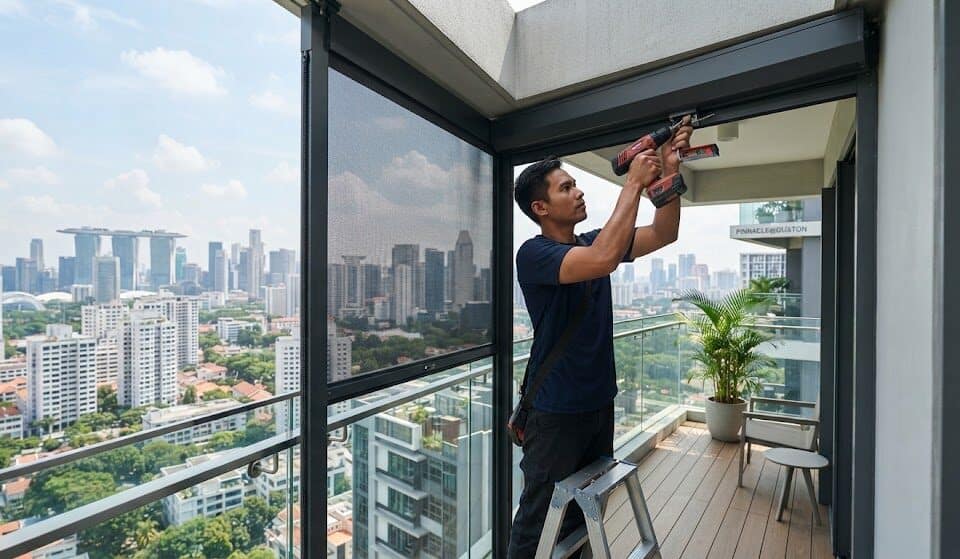
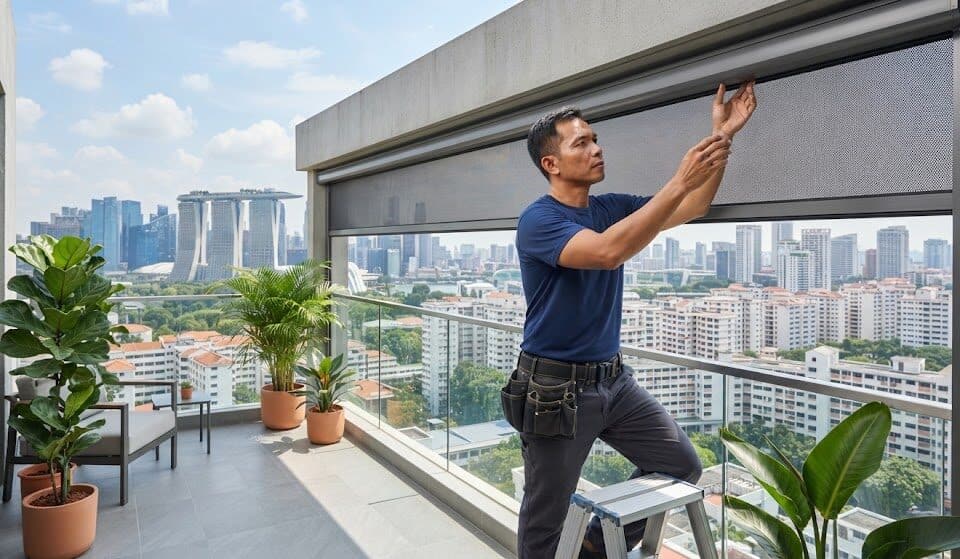
- High-Tension Side-Retaining Splines (Zip Track Systems): For vertical blinds, standard free-hanging bottom bars bounce violently against balcony railings during squalls, risking shattered glass balustrades. Modern motorized zip systems lock the fabric edge inside high-density PVC side channels using a continuous welded core spline, transforming the screen into a rigid, wind-resistant barrier capable of handling Beaufort Force 8 to 9 winds (up to 75–85 km/h).
Hard Roofing Science for Landed Properties: Solving the Acoustic and Thermal Equation
For landed homeowners across estates in Serangoon Gardens, Bukit Timah, and Siglap, sheltering large car porches, side setbacks, and rear outdoor kitchens requires permanent, structural protection. However, building an outdoor hard roof in Singapore introduces two major physical challenges: extreme acoustic reverberation during monsoons and intense downward thermal radiant transfer during heatwaves.
Selecting the right structural hard roof material directly dictates whether your outdoor patio is a peaceful sanctuary or an unbearable, deafening hotbox.
The Acoustic Dilemma: Eliminating the “Tin Roof” Drum Effect
Tropical cloudbursts drop massive kinetic water droplets. When heavy monsoon rain impacts traditional solid polycarbonate sheets or uninsulated single-skin metal decking, the impact generates noise levels exceeding 75 to 85 decibels (dB)—equivalent to standing right next to heavy highway traffic. This intense acoustic reverberation renders conversation impossible and reverberates into adjacent ground-floor living spaces.
Homeowners seeking a permanent outdoor shelter should consider heavy-duty outdoor roofing constructed with insulated sandwich composite panels. These systems feature an exterior skin of pre-painted structural steel or architectural aluminum bonded to a dense Polyisocyanurate (PIR) or High-Density Polyurethane (PU) core. The high-density cellular foam core absorbs and dissipates the kinetic energy of falling raindrops, cutting perceived rainfall noise by up to 60% compared to hollow polycarbonate or glass canopies.
Thermal Isolation and Condensation Management
Solid clear glass canopies, while visually elegant, act as giant magnifying lenses under direct midday sunlight. Without expensive Low-E ceramic coatings or secondary under-slung shades, the area beneath a glass roof becomes an unusable heat trap, radiating extreme temperatures downward onto your tiled porch.
Insulated composite panel roofing completely blocks direct solar transmittance (g-tot value below 0.05). The integrated foam core acts as a high-performance thermal break, preventing the outer metallic skin (which can heat up to 65 degrees Celsius under direct Singapore sun) from transferring thermal energy to the ceiling underside. The result is a cool, shaded outdoor environment that stays close to ambient air temperature even during midday peak heat advisories.
- The 15-Degree Minimum Pitch Rule: Retractable folding-arm awnings must be installed with a minimum downward slope of 15 degrees (roughly 25cm drop per meter of projection). A flatter pitch causes rainwater to pool in the center of the fabric, forming a heavy water hammock that bends the support arms and tears the seams.
- High-Capacity Gutter Sizing: Landed patio roofs must incorporate oversized perimeter gutters (minimum 150mm width) and dual downpipes sized to evacuate sudden torrential downpours exceeding 100mm/hr without overflowing into neighboring lots.
- Chemical Anchor Embedment Depth: Heavy cantilevered canopies fastened to reinforced concrete structural beams require minimum 100mm–120mm chemical capsule embedment depths, fully certified by a licensed Professional Engineer (PE).
Hydrostatic Water Column Pressure vs. Wind Survival Resistance
Engineering performance spectrum mapping outdoor shading and roofing typologies by water pressure tolerance (mm H2O) and certified wind velocity resistance (km/h).
Long-Term Maintenance: Defeating Tropical Mold and Corrosion
Even the highest-grade architectural shades will degrade prematurely if maintained with improper cleaning practices. Singapore’s ambient atmospheric humidity (frequently hitting 95% during monsoon cycles) combined with urban traffic soot creates an ideal environment for microbial proliferation.
To ensure your shading or roofing installation achieves its intended 10-to-15-year operational lifespan, follow these professional maintenance protocols:
1. The Never-Roll-Wet Golden Rule
While high-performance fabrics are treated with antimicrobial coatings, rolling up a soaking-wet fabric awning or motorized vertical blind traps stagnant moisture inside the dark aluminum cassette box. Deprived of sunlight and airflow, microscopic fungal spores germinate within 48 to 72 hours, resulting in deep, unsightly black mold blooms that permanently stain the fabric fibers. If your shade gets drenched during an afternoon storm, retract it temporarily if wind dictates, but extend it fully to air-dry as soon as the weather clears.
2. Bi-Annual Track and Hardware De-Salination
Properties located within 3 kilometers of the coast (including Marine Parade, Pasir Ris, and Sentosa Cove) experience airborne salt aerosol deposition. Over time, salt crystals accumulate inside the aluminum side tracks and around stainless steel motor shafts, increasing mechanical friction and causing motor strain. Every six months, flush the vertical guide channels with low-pressure fresh water and apply a dry-film PTFE (Teflon) lubricant spray. Avoid using oily WD-40 lubricants, as petroleum-based oils attract urban road dust and turn into abrasive grinding paste inside the tracks.
Frequently Asked Questions Regarding Extreme Weather Shading
How do I calculate the g-tot value of an outdoor shade for BCA Green Mark compliance?
The total solar energy transmittance (g-tot) is calculated under European Standard EN 13363-1 or EN ISO 52022-1. It evaluates the combined solar performance of the specific glass type (its visual transmittance and solar heat gain coefficient) and the external shading material (its solar transmittance, reflectance, and openness factor). High-performance exterior fabrics paired with double-glazed low-E units typically achieve a g-tot value below 0.10, successfully blocking over 90% of incoming solar heat to earn maximum BCA Green Mark points.
Why do retractable awnings form sagging water pockets during heavy rain?
Water pooling occurs when an awning is installed with insufficient pitch or has lost internal arm spring tension. In Singapore’s climate, where tropical cloudbursts deliver massive volumes of water in minutes, an awning requires a minimum 15-degree pitch (roughly 25cm of drop per meter of forward projection) to allow gravity to shed water faster than it accumulates. Installing an awning with inadequate pitch allows water weight to stretch the fabric weave and warp the articulated aluminum arms.
How do insulated sandwich panel roofs reduce acoustic rain noise compared to polycarbonate sheets?
Polycarbonate sheets are thin, rigid, and single-layered, causing them to act as acoustic sounding boards that vibrate and amplify raindrop impacts up to 80 decibels. Insulated sandwich panels incorporate a dense internal core of Polyisocyanurate (PIR) or High-Density Polyurethane (PU) sandwiched between structural metal skins. This dense, closed-cell core disrupts sound wave transmission and absorbs kinetic impact energy, dampening rainfall noise down to a comfortable, quiet hum.
What is the response latency of smart anemometer sensors during sudden Sumatran squalls?
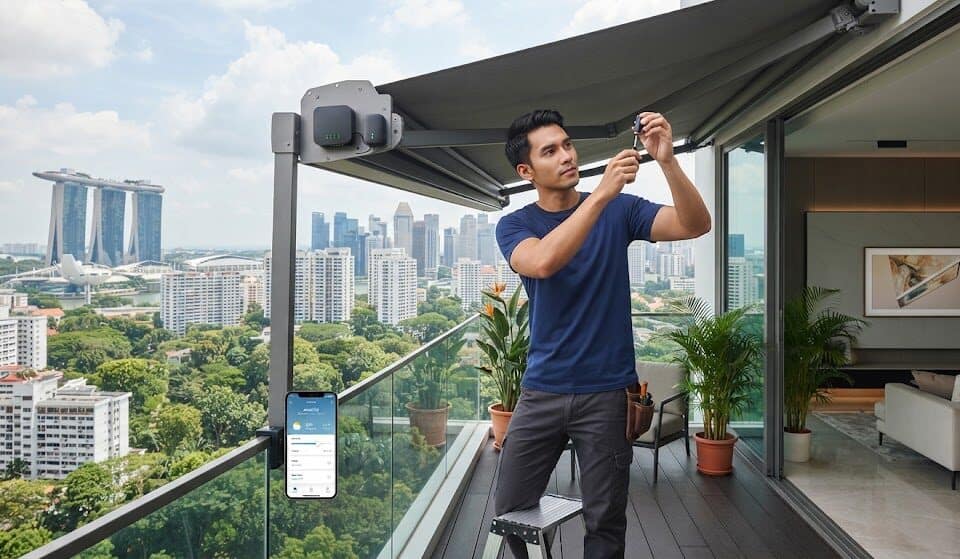
High-grade wireless or hardwired anemometer wind sensors sample wind velocity at 2-to-3-second intervals. When localized wind gusts exceed the programmed safety threshold (typically set between 35 km/h and 45 km/h), the sensor signals the internal tubular motor to begin immediate retraction. Full cassette retraction takes approximately 15 to 25 seconds depending on the total projection span, safely housing the fabric before damaging peak vortex forces can build up.
How do I prevent black mold and algae growth on outdoor shade fabrics in Singapore?
Preventing mold growth requires choosing 100% solution-dyed acrylic or PVC-coated fiberglass fabrics infused with hydrophobic and fungicidal fluorocarbon treatments. Maintenance-wise, never leave the fabric rolled up inside its cassette while wet for extended periods. Clean the surface twice a year with a soft-bristle brush, lukewarm water, and mild pH-neutral soap to remove accumulated tree pollen and organic road dust, which serve as the primary food source for mold spores.
Engineer Your Home for Singapore’s Climate Extremes
Beating Singapore’s relentless heatwaves and extreme monsoon storms requires more than cosmetic fixes. It demands structural shading systems engineered specifically for high thermal deflection, robust hydrostatic head resistance, and proven wind shear stability. Choosing the wrong materials leaves your home vulnerable to sweltering indoor temperatures, costly water damage, and premature structural failure.
Take control of your home’s thermal envelope and outdoor comfort. Partner with certified shading specialists who understand BCA structural standards, URA building envelope guidelines, and the precise aerodynamics of Singapore’s tropical microclimate. Schedule a comprehensive on-site technical consultation today to evaluate your property’s solar exposure, calculate custom wind load tolerances, and install an outdoor shading solution built to endure the elements for years to come.