Maximizing F&B Outdoor Refreshment Areas (ORA): 2026 Commercial Awning & Canopy Guidelines in Singapore
August 12, 2026
Singapore BTO & New Condo TOP Balcony Setup Checklist: Blinds, Awnings, or Canopies? (2026 Guide)
August 14, 2026Retrofitting Smart Home Automation & Automated Weather Sensors for Motorized Awnings & Blinds in Singapore (2026 Guide)
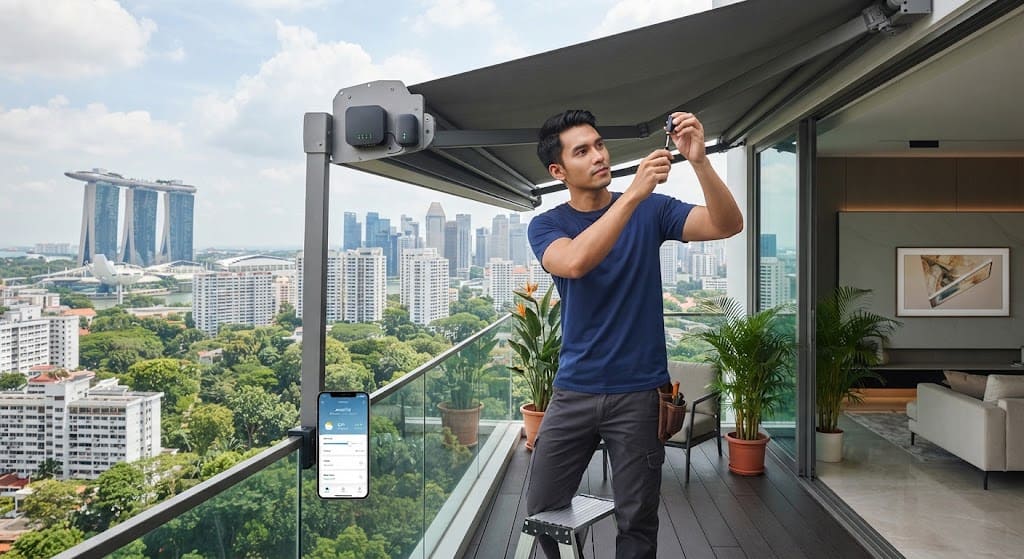
Retrofitting motorized outdoor shading with Matter, Zigbee, and automated anemometer sensors in Singapore.
Every Singaporean homeowner who has ever owned a manual hand-crank awning knows the sudden dread of an unexpected afternoon storm. You are sitting in an office meeting at Raffles Place or having lunch at a hawker centre, only to look out the window and see the sky turn dark charcoal. Within minutes, a violent Sumatran squall rolls in across the island. Back home, your cantilevered patio awning is fully extended, catching 70 km/h wind gusts like an open spinnaker sail, while rain lashes your balcony furniture.
Even if you upgraded to a motorized system with a handheld remote control, the limitation remains the same: it requires human intervention. If nobody is home to press the button, your shading system cannot protect itself from storm damage, nor can it deploy autonomously to block the blistering 2:00 PM western sun that cooks your living room. The traditional remote control is no longer enough for modern high-rise and landed residential living.
Retrofitting smart home automation, connected IoT controllers, and autonomous environmental sensors transforms passive shades into intelligent architectural systems. By integrating platforms like Apple HomeKit, Google Home, Matter, Home Assistant, and Tuya Smart Life with real-time anemometers and optical rain sensors, your awnings and outdoor blinds can automatically track the sun to slash your SP Group electricity bills while instantly retracting to safeguard their mechanical frames during severe tropical downpours.
Motorization Architectures and Retrofit Feasibility
Before diving into wireless protocols and smart sensors, you need to understand the mechanical foundation. Can an existing manual crank awning or standard motorized blind be upgraded without replacing the entire physical structure? In most cases, the answer is yes, provided the primary roller barrel and mounting brackets remain structurally sound.
Converting a manual outdoor shade into a smart-enabled system involves replacing the manual eyelet gearbox with an internal tubular motor inserted directly inside the existing aluminum roller tube.
Tubular Motor Sizing and Torque Calibration
Selecting the right motor requires calculating the mechanical torque (measured in Newton-meters, Nm) needed to lift the combined weight of the fabric, bottom load bar, and internal arm springs under dynamic tension:
- Standard Balcony Zip Blinds (Spans up to 3.5 meters): Typically require a 20 Nm to 35 Nm tubular motor with an operational speed of 15 to 28 rpm. These motors operate quietly and fit within standard 50mm to 60mm diameter roller tubes.
- Medium-to-Large Retractable Awnings (Projections up to 3.0 meters): Require heavy-duty 40 Nm to 55 Nm tubular motors to overcome the strong resistance of internal articulated arm springs during the final 20% of cassette closure.
- Wide-Span Landed Patio Canopies (Spans exceeding 6.0 meters): Demand 80 Nm to 120 Nm industrial-grade motors mounted inside thick-walled 78mm or 85mm galvanized steel barrels to prevent tube deflection under heavy wind loads.
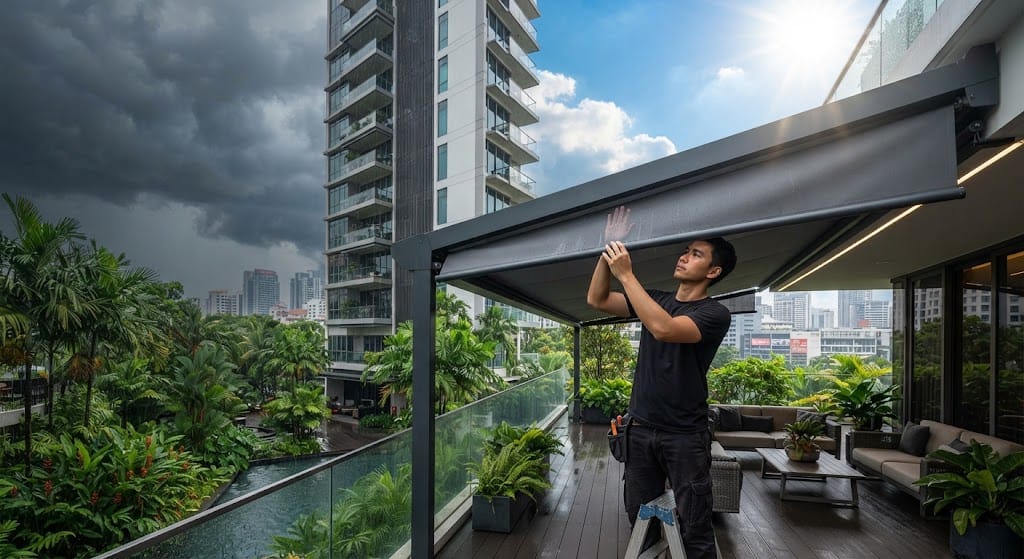
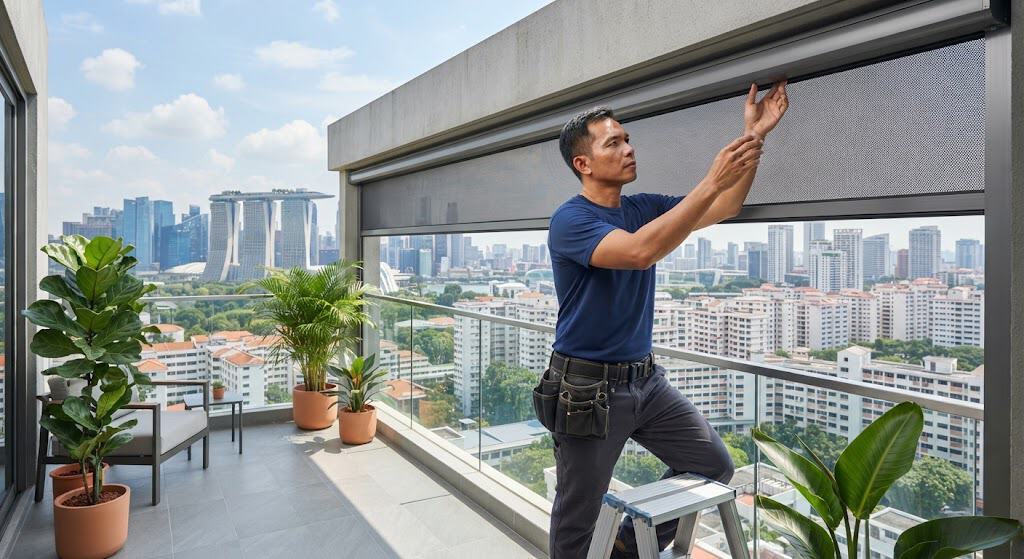
When planning an upgrade, seeking expert motorized awning installation and repair guarantees that your motor’s internal limit switches, electronic obstacle-detection sensors, and structural anchor brackets are correctly matched and calibrated to prevent motor burnout.
Power Delivery: Mains 230V AC vs. Solar-Assisted DC Motors
One common hurdle in private condominiums and high-rise HDB flats is the lack of an existing exterior electrical power point on the balcony. Homeowners have two main engineering routes for powering their smart motors:
- Hardwired 230V AC Direct Feed: The most reliable option for heavy awnings and daily smart routines. A licensed electrical worker (LEW) taps power from an adjacent living room 13A socket or air-conditioning isolator, routing cable through a dedicated IP66 weatherproof outdoor junction box.
- Low-Voltage DC Battery Motors with Solar Trickle Panels: For condominium balconies where MCST by-laws strictly forbid external electrical surface trunking, high-torque 12V or 24V DC tubular motors equipped with integrated lithium-ion battery packs offer a wire-free retrofit. A compact, monocrystalline solar panel mounted on top of the aluminum headbox continually trickle-charges the battery using ambient tropical sunlight, providing months of autonomous operation without mains power.
Wireless Protocols and Smart Home Ecosystem Integration
The biggest evolution in motorized shading over recent years is how these devices communicate. Legacy motorized blinds relied on proprietary 433.92 MHz Radio Frequency (RF) signals (such as Somfy RTS, Dooya, or A-OK protocols). While reliable across short distances, standard 433 MHz RF is a “dumb” one-way protocol: the motor cannot report its current position back to your smartphone, meaning you never truly know if your blind is open, closed, or halfway down when you check your phone remotely.
Modern retrofits bridge these legacy systems into bidirectional, intelligent smart home ecosystems.
Bridging Legacy 433 MHz RF to Smart Ecosystems
If your home already has motorized awnings with standard 433 MHz RF remote controls, you do not need to tear out the motors. You can bridge them into Apple HomeKit, Google Assistant, Amazon Alexa, or Home Assistant using a smart RF-to-Wi-Fi gateway (such as a Bond Bridge, BroadLink RM4 Pro, or manufacturer-specific smart bridges like the Somfy TaHoma switch).
These bridges capture the RF remote signals and translate them into IP commands, allowing you to trigger shade deployment via smartphone apps, customized geofencing routines (e.g., auto-closing blinds when everyone leaves the home), or voice commands through smart speakers.
The Rise of Matter-over-Thread and Zigbee 3.0
For new installations and complete motor replacements, smart shading has moved toward native mesh protocols:
- Matter over Thread: Matter is the unifying smart home standard supported by Apple, Google, Amazon, and Samsung. Thread provides a low-power, low-latency self-healing mesh network designed specifically for smart devices. A Matter-enabled tubular motor communicates locally with your home hub (like an Apple TV 4K or HomePod) without relying on third-party cloud servers. If your home broadband goes down, your automated rain and wind safety routines continue running locally without interruption.
- Zigbee 3.0: Operating on the 2.4 GHz spectrum via dedicated hubs (such as Tuya or Aqara gateways), Zigbee motors deliver two-way feedback, reporting exact percentage opening states (e.g., “Set Balcony Blind to 45%”) with minimal battery consumption.
All radio-frequency hardware imported or retrofitted into Singapore homes must adhere to technical standards established by the Infocomm Media Development Authority (IMDA). Ensuring your smart hubs and sensors operate within authorized Short Range Device (SRD) frequency allocations (433.05–434.79 MHz, 868–870 MHz, and 2.4 GHz bands) avoids signal jamming and protects neighboring smart devices from interference.
| Communication Protocol | Ecosystem Compatibility | Concrete Signal Penetration | Power Consumption | Local Execution & Latency | Estimated Upgrade Cost |
|---|---|---|---|---|---|
| Legacy 433 MHz RF (Somfy RTS / Dooya) |
Requires RF Smart Bridge for app/voice control | Superior Passes through dense walls |
Ultra-Low (One-way transmission) | Local only; no bidirectional status feedback | Lowest (S$80 – S$180 per bridge) |
| Zigbee 3.0 (Tuya / Aqara) |
Native via Hub (Google, Alexa, HomeKit via bridge) | Moderate Requires mesh router nodes |
Very Low (Multi-year battery life) | Sub-second local latency; reports exact % position | Affordable (S$150 – S$320 per motor) |
| Matter over Thread (Apple / Google / Eve) |
Universal Native (HomeKit, Google, Alexa, SmartThings) | High Self-healing Thread mesh |
Extremely Low (Optimized for IoT) | Instant zero-cloud local execution; high reliability | Mid-High (S$280 – S$450 per motor) |
| Direct Wi-Fi (2.4 GHz) (Tuya Smart Life) |
Google Home & Amazon Alexa native | Poor Struggles through Low-E glass |
Moderate-High (Constant Wi-Fi polling) | Cloud-dependent; 1–3 sec delay if internet lags | Budget (S$120 – S$220 per motor) |
| Hardwired KNX / RS485 (Luxury Automation) |
Integrates into high-end Control4, Crestron, Lutron | Immune Physical shielded copper wiring |
Mains Powered (Continuous direct feed) | Zero latency; 100% deterministic reliability | Premium (S$800 – S$1,800+ per zone) |
Intelligent Sun Tracking and Dynamic Balcony Deployment
Pairing smart motorization with astronomical algorithms unlocks automated solar tracking. Singapore’s solar path creates intense, low-angle afternoon sunlight that strikes west-facing facades directly between 2:30 PM and 5:45 PM daily. In districts like Jurong West, Tengah, and Woodlands, this heat penetration spikes indoor temperatures, forcing air conditioning compressors to run at maximum power.
By scheduling motorized retractable awnings to extend automatically when local solar irradiance breaches 40,000 Lux, you intercept thermal infrared radiation before it touches the glass building envelope. When the sun sets below the horizon, the smart system retracts the canopy, allowing evening breezes to naturally cool the balcony without human intervention.
Smart Weather Automation Logic & Priority Overrides
Hierarchical decision-tree execution flow illustrating environmental triggers, optical sensor refraction, and emergency high-wind retraction overrides.
The real intelligence of modern weather retrofitting lies in strict failsafe hierarchy. Solar extension routines are strictly subordinate to wind and rain safety rules. Even if the sun is shining brightly during a sudden gusty downpour, the system prioritizes structural survival, locking the motor in its fully retracted position until wind speeds remain below safe thresholds for at least 15 continuous minutes.
The Sensor Matrix: Rain, Wind, Sunlight, and 3D Vibration Dynamics
A smart shading motor is only as good as the telemetry feeding it. In Singapore’s volatile tropical environment, relying on cloud-based weather apps to trigger your balcony blinds is a recipe for disaster. Public weather forecasts report meteorological station updates with a 15-to-30-minute delay—far too slow to protect a cantilevered awning when a localized Sumatran squall descends over your specific block in Marine Parade or Jurong East.
True structural protection and automated climate control require localized, physical sensors installed directly on your building facade. Understanding how different sensor technologies operate in our humid, high-salinity environment prevents false alarms and ensures instant reaction speeds.
Optical Infrared Rain Sensors vs. Conductive Grid Sensors
Early automated rain systems utilized conductive printed circuit board (PCB) grids. When raindrops bridge the copper traces on the sensor surface, electrical resistance drops, triggering a motor retraction command. In Singapore, these basic conductive sensors suffer from chronic false triggers. Our early-morning ambient relative humidity (often exceeding 90%) and heavy dew condensation bridge the traces, causing awnings to lock in their retracted positions even on clear, sunny mornings. Over time, urban road soot and acidic rain cause the exposed copper tracks to corrode, resulting in complete sensor failure.
Modern retrofits use optical infrared refraction sensors housed behind hermetically sealed polycarbonate domes:
- Internal Beam Refraction: An infrared LED bounces light against the internal surface of the lens back to an optical receiver. When raindrops strike the outside surface, the angle of refraction changes, altering the internal light intensity.
- Immunity to Moisture and Soot: Because the electrical components remain completely isolated inside a sealed enclosure, the sensor is unaffected by surface dew, coastal salt air, or atmospheric grime.
- Instant Millisecond Trigger: The sensor detects the impact of the very first kinetic raindrops, signaling the motor to close before water can accumulate on extended fabric canopies.
Cup Anemometers vs. 3D Kinetic Vibration Accelerometers
Traditional wind protection systems rely on spinning cup anemometers mounted on an external mast. While effective on open landed rooftops, mechanical wind cups encounter major operational problems on high-rise condominium balconies. Aerodynamic down-drafts and wall-vortex turbulence create localized dead zones where wind cups spin erratically or get shielded by neighboring architectural pillars. Airborne dust and construction grit frequently seize the miniature bearings, leaving the system blind to high-velocity horizontal gusts.
The contemporary engineering solution is a wireless 3D kinetic vibration accelerometer mounted directly inside the awning’s front aluminum load bar. Instead of measuring wind speed in the air, the sensor measures actual physical movement:
- Tri-Axial G-Force Detection: The internal MEMS (Micro-Electro-Mechanical Systems) accelerometer measures movement across the X, Y, and Z axes simultaneously, tracking vertical flapping, horizontal twisting, and diagonal shock oscillation.
- Calibrated Threshold Sensitivity: Homeowners can set custom sensitivity levels. If a sudden wind gust causes the front load bar to bounce beyond a calibrated acceleration threshold (e.g., 0.5G to 0.8G of dynamic force), the sensor instantly triggers an emergency retraction command.
- Self-Contained Wireless Operation: Powered by long-life lithium batteries that last three to five years, these compact units require zero external wiring running through the awning arms, communicating with the motor via secure, encrypted radio signals.
Smart Home Energy Automation and SP Group Utility Reduction
Automated shading retrofits do more than protect hardware; they actively cut household energy expenditure. In Singapore, air-conditioning accounts for approximately 40% to 50% of an average household’s monthly electricity bill. The cooling load on your inverter air conditioner is directly tied to the volume of solar heat penetrating your exterior windows and glass balcony doors.
Our island’s diurnal solar heat curve creates a predictable thermal load. Peak solar radiation hits eastern facades from 8:30 AM to 11:30 AM, shifts directly overhead from 12:00 PM to 2:00 PM, and punishes western facades from 2:30 PM to 5:45 PM. Leaving your balcony unshaded during these hours allows solar heat to saturate internal walls, tile floors, and furniture, creating a thermal mass that continues to radiate heat well past 9:00 PM.
Diurnal Solar Heat Ingress vs. Automated Shading Energy Profile
Hourly comparative thermal ingress (Watts per square meter) and HVAC cooling energy consumption across unshaded, manually operated, and smart automated shading systems in a Singapore home.
Quantifying Thermal Load Reductions
By programming smart shading schedules tied to real-time lux sensors, you achieve measurable thermodynamic benefits:
- Internal Ambient Temperature Drop: Intercepting solar radiation outside the glass envelope lowers indoor ambient temperatures by 4 to 7 degrees Celsius during peak afternoon hours.
- Compressor Cycling Reductions: With external shading deployed, multi-split inverter air conditioners reach their target temperature (e.g., 24°C) up to 40% faster, allowing the compressor to step down to its lowest power-saving frequency instead of running continuously at maximum wattage.
- Tangible Monthly Utility Savings: Under standard SP Group residential electricity tariffs, automated shading reduces air conditioning energy consumption by approximately 25% to 35% across east- and west-facing units, resulting in recurring monthly savings that offset the initial retrofit cost within two to three years.
- Verify Motor Barrel Diameter & Wall Gauge: Ensure your existing awning roller tube has a minimum 50mm internal diameter (or 70mm for wide spans) with adequate wall thickness to support internal motor spline insertion.
- Confirm 13A IP66 Weatherproof Electrical Feed: Check that outdoor power circuits are connected to an independent residual current circuit breaker (RCCB) to prevent nuisance trips during thunderstorms.
- Measure Wireless RF & Wi-Fi Penetration: Test 2.4 GHz Wi-Fi and Thread mesh signal strength on the balcony with the heavy sliding glass doors fully closed, as Low-E coatings can attenuate high-frequency radio signals by up to 15 dB.
- Program High-Wind Priority Overrides: Ensure the smart motor controller’s firmware has a hardcoded wind-retract priority that cannot be superseded by cloud schedules, manual app inputs, or voice commands.
Advanced Smart Automations: Geofencing, Voice Control, and Custom Scenes
Once your motorized shading system is bridged into a modern smart home platform, you can build customized routines tailored to your daily family lifestyle:
1. Location-Based Geofencing Routines
Using Apple HomeKit or Google Home geofencing, your smart home detects when the last family member leaves the unit. The system automatically verifies that all motorized outdoor blinds are lowered to secure the balcony from afternoon rain and sun, while confirming that cantilevered patio awnings are retracted into their protective cassettes. When you return within a 500-meter radius of your estate, the system can trigger an evening scene, opening the shades to welcome you home with natural sunset views.
2. Hands-Free Voice Control Integration
Connecting your shades to smart voice assistants eliminates the need to search for misplaced remote controls. Simple voice commands (“Hey Siri, set balcony blind to 50%”, “Hey Google, open the patio awning”, or “Alexa, close outdoor screens”) allow effortless operation while cooking in the kitchen, entertaining guests on the sofa, or carrying heavy laundry baskets to the service yard.
3. Home Assistant & Local MQTT Automations for Power Users
For smart home enthusiasts using Home Assistant, local Zigbee2MQTT integration provides deep, unconstrained automation possibilities. You can combine localized outdoor temperature sensors, indoor room thermostat data, and real-time open-data APIs from the National Environment Agency (NEA) to create sophisticated multi-variable execution rules without sharing personal usage telemetry with third-party cloud servers.
Frequently Asked Questions Regarding Smart Awning Retrofits
Can I convert my existing manual hand-crank awning to a motorized smart system?
Yes. If the structural mounting brackets, aluminum cassette, and roller tube are in good physical condition, a certified technician can remove the manual eyelet gearbox and slide a high-torque tubular motor directly inside the roller barrel. Once wired to a power source or fitted with a solar-assisted battery pack, the motor can be paired with smart home hubs, remote controls, and automated weather sensors.
How do I integrate an existing 433 MHz Somfy or Dooya motor into Apple HomeKit?
Legacy 433.92 MHz RF motors cannot communicate directly with Apple HomeKit. To bridge them, you need a smart RF gateway such as a Bond Bridge, BroadLink RM4 Pro, or manufacturer-specific smart hub (like the Somfy TaHoma switch) paired with Homebridge or a Matter-compatible bridge. This translates HomeKit network commands into localized radio frequency signals, enabling full voice control and automation.
What happens to motorized awnings during a sudden thunderstorm if there is a power outage?
Standard 230V AC hardwired motors will pause operation if mains electricity cuts out. To protect against this scenario in exposed landed homes or high-floor penthouses, you can install tubular motors equipped with integrated manual override eyelets (allowing manual hand-crank retraction during emergencies), DC battery backup systems, or dedicated uninterrupted power supply (UPS) units connected to the motor circuit.
Why do rotating cup anemometers fail on high-rise balconies, and what is the alternative?
Rotating cup anemometers struggle in high-rise environments because building facades create aerodynamic dead zones, downdrafts, and localized turbulence that prevent the cups from measuring true wind velocity accurately. Furthermore, airborne dust and debris can jam the mechanical bearings. The superior alternative is a wireless 3D kinetic vibration accelerometer mounted directly inside the awning’s front load bar, which measures actual physical G-force movement and instantly triggers retraction if the frame begins to oscillate dangerously.
Are imported smart motor hubs compliant with Singapore’s IMDA wireless regulations?
Smart motor hubs and radio transceivers must comply with short-range radio device (SRD) regulations set by the Infocomm Media Development Authority (IMDA). In Singapore, authorized operating frequencies include 433.05–434.79 MHz, 868–870 MHz, and standard 2.4 GHz Wi-Fi/Zigbee/Thread bands. Using non-approved frequency hardware imported from unauthorized regions can cause severe radio interference and violates local telecommunications statutes.
Upgrade Your Balcony with Intelligent Weather Automation
Transforming your manual awnings or basic motorized blinds into an intelligent, sensor-driven shading system is one of the highest-return upgrades you can make to your home. Beyond eliminating the daily hassle of manual adjustment, smart automation delivers 24/7 autonomous protection against destructive monsoon squalls, maintains lower indoor room temperatures, and steadily lowers your monthly SP Group electricity bills.
Take the guesswork out of smart outdoor weatherproofing. Work with certified shading automation specialists who understand mechanical torque calculations, high-rise structural wind dynamics, and seamless smart home platform integration across Apple HomeKit, Google Home, Matter, and Tuya. Schedule a comprehensive on-site smart retrofit assessment today to evaluate your existing hardware, review power routing options, and calibrate a customized, intelligent shading system built for your home.