Glass Canopies vs. Traditional Awnings for Singapore Landed Property Car Porches (2026 Architectural & Cost Guide)
August 10, 2026
Maximizing F&B Outdoor Refreshment Areas (ORA): 2026 Commercial Awning & Canopy Guidelines in Singapore
August 12, 2026Emergency Awning Repair & Fabric Replacement: Singapore Homeowner’s Diagnostic & Cost Guide (2026)
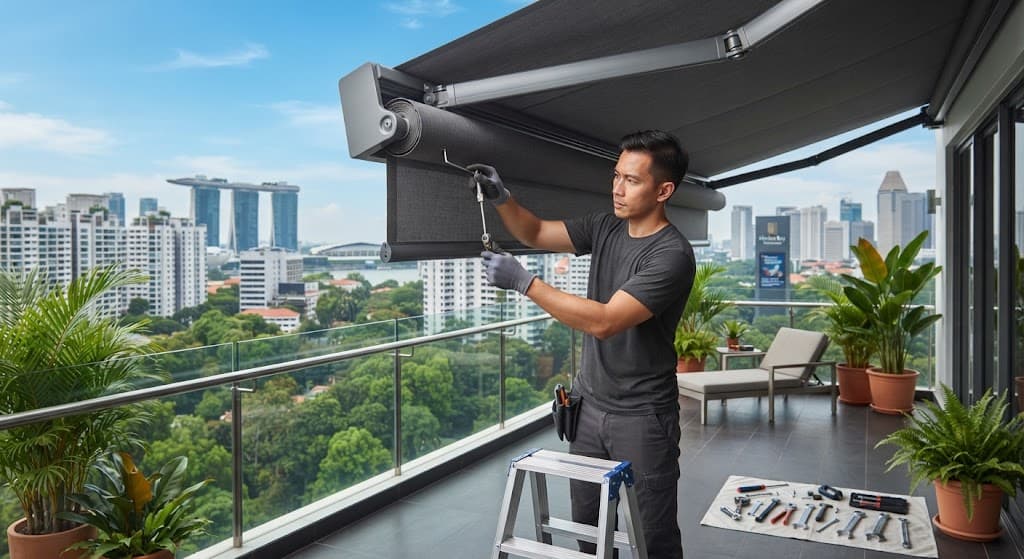
Diagnosing structural arm damage, tubular motor failure, and replacing degraded awning fabrics for Singapore properties.
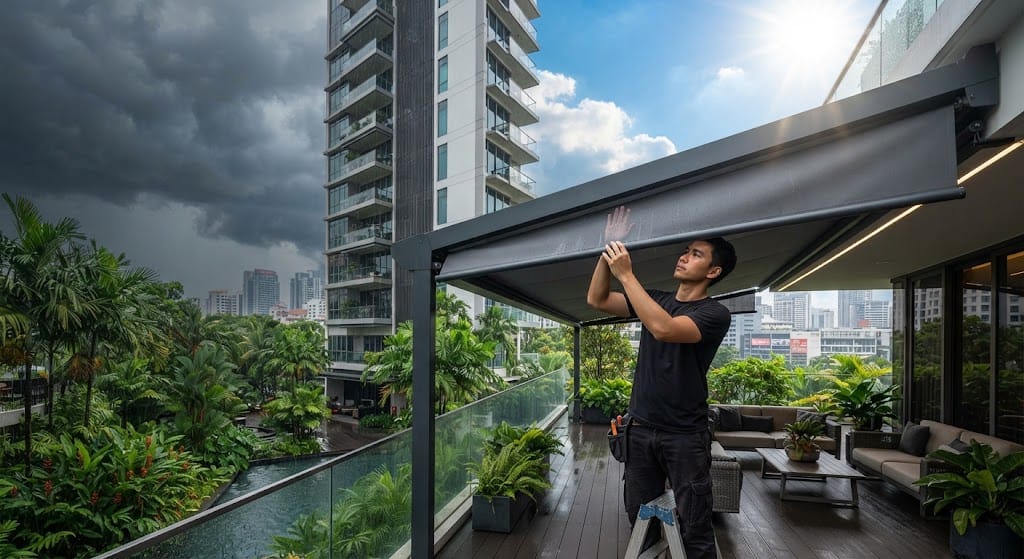
Every Singaporean homeowner who has experienced a severe monsoon downpour knows how quickly a minor outdoor fixture issue can turn into an urgent crisis. You are at home during a violent afternoon Sumatran squall, watching wind gusts of up to 75 km/h slam into your patio. Suddenly, you hear a sharp tearing sound as aged fabric rips along a seam, or the motorized retractable awning jams halfway during an emergency retraction, leaving a three-meter cantilevered aluminum frame bouncing violently in the wind.
When an awning fails during extreme weather, your immediate instinct might be to panic. Homeowners often repeatedly press the remote control buttons or attempt to physically push the heavy metal arms back into place. Doing so is dangerous. Forcing a stuck tubular motor will burn out its internal start capacitor, while pushing against high-tension spring-loaded arms can strip mechanical gear teeth or cause structural anchor bolts to tear straight out of your concrete wall.
Understanding how to safely stabilize a damaged awning, diagnose the root mechanical issue, and determine whether you need a minor component fix or full fabric replacement saves you thousands of dollars. In many cases, you do not need to discard your entire expensive aluminum frame. By targeting specific mechanical repairs or executing a professional canvas re-skinning, you can restore full weather protection quickly and cost-effectively.
First-Response Emergency Triage: Immediate Actions to Take
If your awning suffers storm damage or freezes in an open position during heavy weather, take immediate steps to stabilize the system before calling for professional assistance. Your primary objective is eliminating falling hazards and preventing secondary structural damage to your building facade.
1. Isolate the Electrical Power Supply
If your awning is motorized and stops responding, do not continue holding down the wall switch or remote buttons. If the motor is jammed mechanically, continuous current will overheat the copper windings and permanently destroy the motor within minutes. Locate your 13A outdoor weatherproof isolator switch or trip the dedicated sub-circuit breaker in your main distribution board (DB) to cut power completely.
2. Secure Flapping Fabric and Stabilize Cantilevered Arms
A half-retracted awning acts as a massive aerodynamic sail. If wind gets underneath loose canvas or a lopsided arm, the upward dynamic uplift can exert hundreds of kilograms of leverage on your wall mounting brackets. Use heavy-duty ratchet straps, bungy cords, or strong nylon rope to lash the front profile bar securely to your balcony balustrade or patio ground anchors. This neutralizes wind lift and prevents the frame from twisting.
3. Beware the Lethal Spring-Loaded Arm Hazard
The articulated folding arms of a retractable awning contain heavy-duty internal steel coil springs or multi-link flyer chains under extreme mechanical tension (often exceeding 1,200 Newtons of force). Never attempt to unbolt the elbow joints or loosen arm mounting knuckles while the awning is open. If an arm snaps closed uncontrollably, the recoil force can cause severe fractures or catastrophic personal injury.
The Diagnostic Framework: Frame Repair vs. Complete Fabric Replacement
Once the weather clears and the system is safely secured, you need to evaluate the physical condition of the hardware. The biggest financial question Singapore homeowners face is whether they must replace the entire awning assembly or simply replace the worn-out fabric canvas.
In over 70% of awning failures across private condominiums and landed properties, the heavy structural aluminum frame remains completely intact. The failure is usually confined to degraded fabric seams, a worn tubular motor, or stripped gearbox teeth.
Assessing Structural Aluminum Frame Integrity
Inspect the core metal components to verify if your frame is safe for continued use:
- Check Arm Alignment and Knuckle Castings: Examine the cast-aluminum elbow knuckles and shoulder joints for hairline fractures or metal fatigue. If the arms are straight, parallel, and show no structural cracking, the mechanical frame is fully salvageable.
- Inspect Wall Mounting Brackets and Concrete Anchors: Check where the main mounting plates meet the concrete beam or soffit. If there is no gap, rust bleed, or concrete spalling around the Grade 316 stainless steel anchor bolts, the structural foundation is sound.
- Examine the Roller Barrel: Check the 70mm or 85mm galvanized steel roller tube. If the barrel is straight and free from structural bowing, it can easily support a new fabric roll.
If your frame exhibits mechanical misalignment, motor buzzing, or loose arm tension, engaging professional awning repair services allows certified technicians to realign the cantilevered geometry, replace worn internal arm springs, or install a replacement high-torque tubular motor without the expense of a full system teardown.
Recognizing When Fabric Re-Skinning is Necessary
In Singapore’s harsh equatorial climate, outdoor fabrics face an unrelenting combination of intense ultraviolet radiation (UV Index 11 to 12) and high relative humidity. Even premium canvases experience material degradation over time. You should replace the fabric if you observe:
- Thread Rot Along Heat-Welded Seams: The fabric panels themselves may look intact, but the structural stitching holding the panels together has disintegrated under UV exposure, causing panels to split open during rain.
- Hydrostatic Coating Depletion: Water no longer beads up and rolls off. Rain soaks directly into the weave, resulting in fine misting and dripping underneath the canopy during standard showers.
- Torn Spline Beads: The flexible PVC spline that anchors the fabric inside the roller tube and front load bar channel has become brittle, cracked, and pulled out of its track.
- Deep Fungal Infiltration: Black mold and algae have penetrated deep into the yarn core after years of being rolled up wet, causing permanent staining and foul odors that cannot be washed away.
Executing a custom retractable awning fabric replacement (also known as canvas re-skinning) allows you to choose modern 100% solution-dyed acrylic textiles that restore 100% waterproof performance, block 95% of solar heat, and revitalize your home’s exterior curb appeal at 40% to 60% of the cost of buying a completely new awning.
| Failure Symptom | Root Mechanical Cause | Repair vs. Replace Action | Estimated Repair Time | Typical Cost Range (S$) |
|---|---|---|---|---|
| Motor Completely Silent (No movement or hum) |
Blown start capacitor, tripped thermal safety overload, or burned internal motor winding. | Component Repair Replace capacitor or swap tubular motor. |
1 to 2 Hours | S$180 – S$450 (Motor size dependent) |
| Fabric Torn Along Seams (Frame fully functional) |
UV degradation of stitching thread and resin coating depletion. | Fabric Re-Skinning Replace canvas; retain aluminum frame. |
2 to 3 Hours (Custom made-to-order) |
S$450 – S$1,200 (Based on span & material) |
| Awning Closes Crooked (One arm lags behind) |
Uneven arm spring tension, stretched internal flyer chain, or misaligned shoulder bracket. | Mechanical Service Re-tension flyer chain & calibrate pitch. |
1 to 2 Hours | S$150 – S$320 |
| Manual Crank Spins Freely (Awning does not move) |
Stripped internal worm gear teeth inside the manual eyelet gearbox. | Gearbox Swap Replace mechanical 1:7 or 1:11 ratio gearbox. |
1 Hour | S$160 – S$280 |
| Bent Articulated Arm (Severe wind storm damage) |
Dynamic wind overload exceeding structural yield point of aluminum profile. | Arm Replacement Replace damaged arm pair; retain roller barrel. |
2 Hours | S$350 – S$750 per arm |
| Wall Anchor Pulled Out (Gap between wall & bracket) |
Improper anchor depth, degraded brickwork, or violent squall uplift. | Urgent Structural Fix Chemical anchor re-embedment & plate reinforcement. |
2 to 4 Hours | S$300 – S$650 |
Awning Failure Diagnostic & Repair Triage Decision Tree
Step-by-step diagnostic workflow guiding homeowners from initial failure symptom to the most cost-effective repair or replacement pathway.
The Anatomy of Professional Awning Fabric Replacement (Re-Skinning)
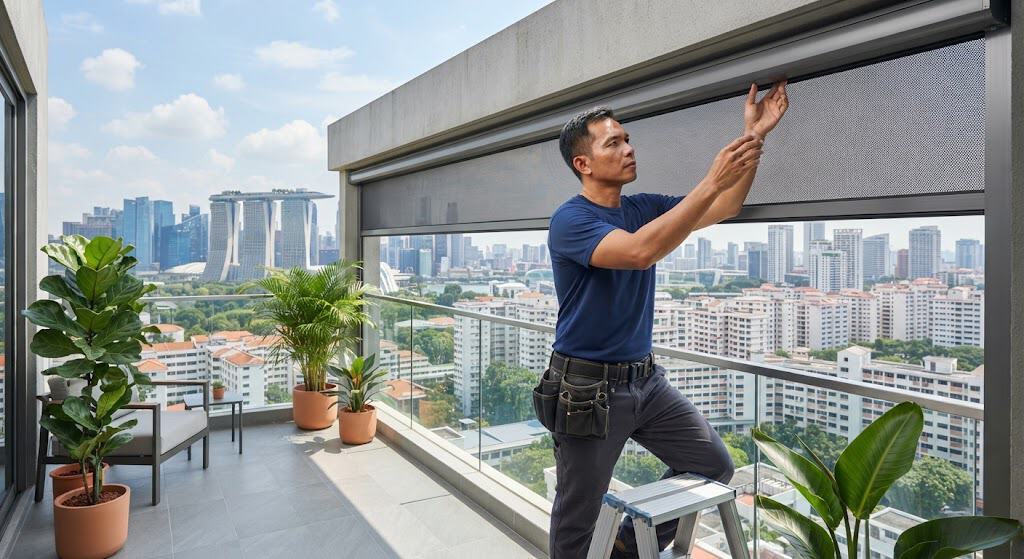
When an awning’s aluminum framework remains structurally solid but the canvas has ripped, faded, or lost its water-repellent coating, executing a complete fabric replacement—known in the industry as re-skinning—is the most economical and sustainable solution. Rather than paying thousands of dollars for a completely new system and drilling new anchor holes into your building facade, re-skinning replaces only the textile membrane while retaining the existing roller barrel, articulated arms, and mounting brackets.
However, re-skinning a high-tension retractable awning is a delicate mechanical procedure that requires specialized tools and strict safety protocols. Understanding the professional replacement workflow highlights why this is not a casual do-it-yourself weekend chore:
1. Precision Site Measurement and Barrel Sizing
Every custom awning has millimeter-specific tolerances. Technicians measure the exact width of the roller barrel, the forward projection of the articulated arms, and the diameter of the spline channels. An error of just 15 millimeters in fabric width can cause the canvas to bunch up unevenly against the end brackets, leading to severe diagonal creasing and motor binding during retraction.
2. Safety Clamping the Articulated Spring Arms
Before the old fabric can be removed, the spring-loaded articulated arms must be extended slightly and locked in place using heavy-duty nylon safety retention straps. Because the internal arm springs exert constant outward pressure, removing the fabric without securing the arms allows them to snap open uncontrollably, causing catastrophic damage to the frame or severe physical injury to the technician.
3. Spline Bead Extraction and Track Preparation
The aged fabric is secured inside the roller tube and front load bar via cylindrical flexible PVC spline beads. Technicians slide the old splines out of their dedicated extrusion channels, inspect the aluminum channels for burrs or corrosion, and vacuum away trapped dirt and grit. The roller barrel is cleaned and inspected for runout or sagging.
4. Installing and Tensioning the New Fabric
The new, custom-sewn fabric panel—equipped with fresh, UV-stabilized polymer spline beads—is threaded simultaneously into the top roller tube and the front profile. Technicians then re-engage the manual crank or tubular motor to roll the fabric evenly onto the barrel under uniform lateral tension, ensuring the fabric rolls perfectly centered without tracking to one side.
5. Calibrating Travel Limits and Pitch Angle
Once the new canvas is installed, the technician recalibrates the motor’s mechanical or electronic travel limits. The closed limit must ensure the cassette seals tightly without over-torquing the fabric, while the extended limit must stop before the fabric sags. Finally, the downward pitch angle is calibrated to at least 15 degrees to guarantee immediate rainwater drainage.
Fabric Tensile Strength & Water Repellency Decay Curve
Projected 10-year degradation timeline of outdoor canopy textiles under equatorial Singapore solar UV irradiance (UV Index 11–12) and 90% ambient relative humidity.
Tubular Motor and Electrical Diagnostics: Solving the Silent Motor
When you press your remote control and the awning does not move, homeowners often assume the entire motor has burned out and requires replacement. In reality, a silent motor is frequently caused by non-catastrophic electrical issues that can be resolved quickly.
Before paying for a complete motor swap, systematic electrical diagnostics should be performed:
1. The Thermal Safety Overload Cutoff
Tubular motors designed for residential awnings are engineered for intermittent duty. They generate significant internal heat within their compact aluminum cylindrical housings. Every certified tubular motor incorporates an internal bi-metallic thermal switch.
If you extend and retract your awning repeatedly within a 4-to-6-minute window while testing or adjusting limit switches, the motor will reach its thermal ceiling (typically around 140 degrees Celsius) and shut off completely to prevent the copper windings from melting. This is normal safety behavior, not a defect. Allow the motor to cool down for 20 to 30 minutes. Once the temperature drops, the thermal switch automatically resets, restoring normal operation.
2. Start Capacitor Failure
Single-phase 230V AC tubular motors rely on an internal microfarad (uF) start capacitor to create the rotational phase shift needed to turn the rotor. In Singapore’s humid environment, these capacitors are the most common electrical point of failure after 4 to 7 years of service.
A failing capacitor exhibits distinct symptoms: when you press the remote, the motor emits a faint electrical buzzing or humming sound, but the roller tube does not turn unless you physically push the front bar by hand. If the motor hums, the primary motor windings are intact; a technician can simply open the motor head and replace the blown capacitor, saving you the cost of a full motor replacement.
3. Electronic Limit Switch Desynchronization
If your awning motor runs continuously without stopping at its designated open or closed points—causing the fabric to unroll backwards around the barrel or jamming the front bar hard against the cassette—the internal mechanical limit switch micro-gears have slipped or the electronic magnetic encoder has lost its memory. Technicians reset the motor’s factory memory using a programming lead and re-establish the top and bottom stop points within minutes.
- Never Release Arm Elbow Bolts Under Tension: Internal spring tension can snap folding arms closed with lethal kinetic force. All mechanical arm repairs must be performed with safety retaining clamps in place.
- MOM Work at Height (WAH) Regulations: For high-floor condominium balconies and landed second-storey installations, ensure your contractor’s technicians hold valid Ministry of Manpower (MOM) Work at Height certifications and utilize full-body fall-arrest harnesses.
- Inspect for Concrete Spalling: Prior to re-skinning an older awning, have the technician inspect the wall anchor zone for concrete hairline cracks or water seepage to ensure structural load safety under BCA guidelines.
Preventive Maintenance: Extending Your Awning’s Operational Lifespan
Simple preventive maintenance routines performed twice a year will double the service life of your newly repaired awning and prevent unexpected storm damage:
The Never-Roll-Wet Golden Rule
Trapping stagnant rainwater inside a tightly wound aluminum cassette creates a dark, humid incubator for fungal spores. While high-performance solution-dyed acrylics are treated with antimicrobial finishes, organic road dust, airborne pollen, and bird droppings sitting on the surface serve as a food source for black mold. If your awning is retracted wet during an afternoon squall, extend it fully on the next sunny morning for at least two hours to allow the weave to air-dry completely.
Semi-Annual Track and Joint De-Salination
Singapore’s ambient air contains airborne salt particles and urban pollutants that settle into the mechanical pivot knuckles and roller bearings. Every six months, rinse the articulated arm joints with a low-pressure garden hose and apply a generous coat of dry-film PTFE (Teflon) spray lubricant. Never use sticky WD-40 or petroleum grease, as wet lubricants attract road grit and turn into an abrasive paste that rapidly grinds down aluminum bushings.
Frequently Asked Questions Regarding Awning Repair & Fabric Replacement
Can I replace just the fabric if the aluminum awning frame is 8 to 10 years old?
Yes. High-grade architectural aluminum frames (such as 6063-T6 extruded aluminum) have an operational lifespan of 15 to 20+ years in Singapore. If the roller barrel is straight, the arm flyer chains are intact, and the wall mounting brackets are securely anchored, executing a professional fabric re-skinning restores full aesthetic appeal and weather protection at roughly 40% to 60% of the cost of a full system replacement.
Why did my motorized awning stop moving after 5 minutes of testing?
Your tubular motor has entered thermal safety overload protection. Operating a residential tubular motor continuously for more than 4 to 6 minutes causes internal heat to trip a bi-metallic safety switch, cutting power to prevent the copper windings from burning out. Leave the motor completely alone for 20 to 30 minutes to cool down; the thermal switch will automatically reset and restore normal function.
How much does full awning fabric replacement (re-skinning) cost in Singapore?
In Singapore, custom fabric re-skinning using premium 100% solution-dyed acrylic textiles (such as Dickson Orchestra or Sunbrella) generally ranges from S$450 to S$1,200, depending on the total width, forward projection span, and accessibility of the installation. This includes precision on-site measurement, off-site custom sewing with UV-resistant thread, new polymer spline beads, and on-site tension calibration.
Can torn seams be repaired on-site without dismantling the entire awning?
Minor localized tears or split seams can occasionally be patched or re-stitched temporarily using specialized marine-grade repair tape or hand-stitching with bonded polyester thread. However, on-site stitching is only a temporary stopgap. When structural stitching begins to rot across multiple seams, the entire fabric has reached the end of its UV lifespan and requires a full re-skinning to withstand heavy wind loads safely.
What should I do if an articulated awning arm gets bent during a severe thunderstorm?
If an arm is bent, immediately isolate the electrical power at the 13A outdoor switch to prevent the motor from straining. Secure the front profile bar to your balcony railing or ground anchors using heavy-duty straps to prevent wind uplift from tearing the brackets off the wall. Do not attempt to bend the aluminum arm back into place or loosen elbow bolts, as internal high-tension springs can snap with dangerous force. Contact a certified awning technician to safely de-tension and replace the damaged arm.
Restore Your Awning’s Weather Protection and Safety Today
A damaged, jammed, or torn awning does not have to mean buying an entirely new system. In most residential and commercial setups across Singapore, targeted mechanical repairs, tubular motor servicing, or a professional fabric re-skinning will completely restore full weather protection, structural safety, and exterior aesthetic appeal at a fraction of the cost of a full replacement.
Never leave a storm-damaged awning unsecured where wind shear can cause facade damage or dangerous falling hazards. Partner with certified awning repair specialists who provide prompt on-site diagnostics, stock genuine replacement parts, and handle precision re-skinning with premium solution-dyed acrylics. Schedule an emergency inspection or request a transparent fabric replacement quotation today to get your outdoor space fully protected rain or shine.